This notebook walks through the provider side of the FAIR2Adapt access control workflow. You will:
Encrypt a dataset with AES-256-GCM
Create an ODRL access policy (JSON-LD)
Wrap the dataset key for a specific consumer’s DID
Step 1 — Load and inspect the dataset
The dataset is a small CSV of synthetic Mediterranean biodiversity observations. In a real scenario, this would be your sensitive research data.
import pandas as pd
from pathlib import Path

DATA_DIR = Path("data")
DATASET_PATH = DATA_DIR / "synthetic-biodiversity-observations.csv"

df = pd.read_csv(DATASET_PATH, comment="#")
print(f"Dataset: {DATASET_PATH}")
print(f"Rows: {len(df)}, Columns: {list(df.columns)}")
df.head()
Step 2 — Encrypt the dataset
The provider encrypts the dataset with a random AES-256-GCM key. The encrypted file can be hosted anywhere (S3, Zenodo, GitHub) — without the key, it’s unreadable.
from fair_data_access.encrypt import encrypt_file, generate_key

KEYS_DIR = Path("keys")

# Generate a random 256-bit symmetric key
dataset_key = generate_key()

# Encrypt the CSV — produces a .enc file alongside the original
encrypted_path, _ = encrypt_file(str(DATASET_PATH), key=dataset_key)
encrypted_path = Path(encrypted_path)

print(f"Original:  {DATASET_PATH} ({DATASET_PATH.stat().st_size:,} bytes)")
print(f"Encrypted: {encrypted_path} ({encrypted_path.stat().st_size:,} bytes)")
print()
print("The encrypted file is safe to host publicly.")
print("Without the dataset key, it is computationally infeasible to decrypt.")
Step 3 — Create the ODRL access policy
The policy declares, in machine-readable form, who can do what with this dataset, under which conditions. It uses the ODRL (Open Digital Rights Language) standard with purpose constraints from the W3C Data Privacy Vocabulary.
This policy says:
✅ Permitted: Use and Reproduce — for Public Benefit purposes
❌ Prohibited: Commercialise and Sell
📋 Duty: Attribute to FAIR2Adapt
The published nanopublication of this policy is: View on Science Live
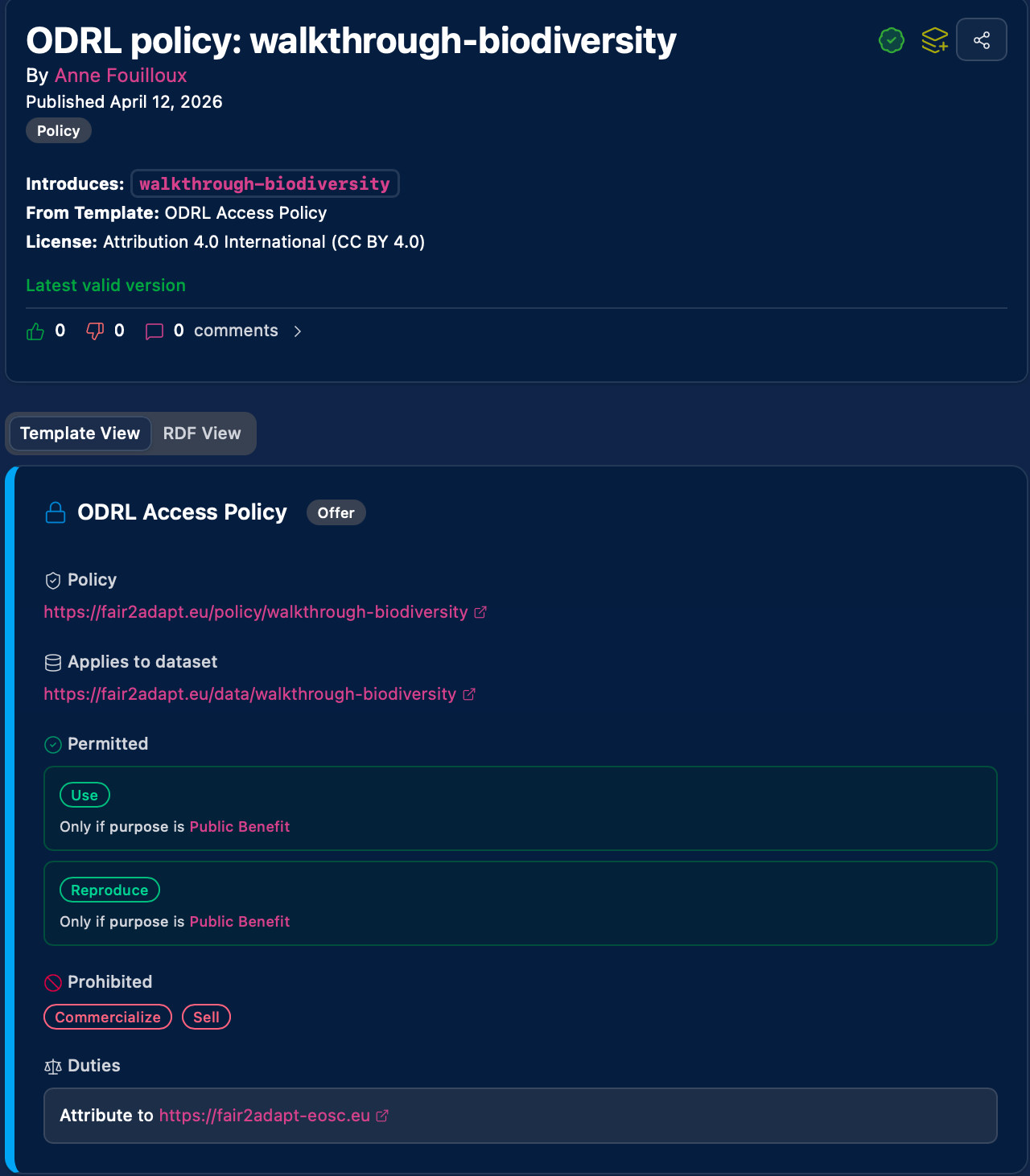
The same policy rendered in the Science Live platform’s ODRL viewer.
import json

POLICY_PATH = Path("policies/example-policy.jsonld")
policy = json.loads(POLICY_PATH.read_text())

print("=== ODRL Access Policy ===")
print(json.dumps(policy, indent=2))
In production, this policy would be published as a signed nanopublication on the decentralised nanopub network, making it immutable, citable, and independently verifiable.
Step 4 — Receive an access request
A consumer identifies themselves with a DID and declares their purpose. In production, this happens via a GitHub Issue (with automated evaluation). Here we simulate it by loading the example consumer’s DID document.
CONSUMER_DID = "did:web:fair2adapt.github.io:fair-data-access:example-consumer"
CONSUMER_DID_DOC_PATH = KEYS_DIR / "did" / "example-consumer.json"

consumer_did_doc = json.loads(CONSUMER_DID_DOC_PATH.read_text())

print(f"Access request received from: {CONSUMER_DID}")
print(f"Declared purpose: Academic Research")
print(f"Consumer's public key curve: {consumer_did_doc['verificationMethod'][0]['publicKeyJwk']['crv']}")
Step 5 — Evaluate the policy
The provider (or an automated workflow) checks whether the consumer’s declared purpose matches the policy’s constraints.
# In production, this is done by fair_data_access.policy.evaluate_policy().
# Here we check manually for clarity.

declared_purpose = "https://w3id.org/dpv#AcademicResearch"
allowed_purposes = [
    c["rightOperand"]["@id"]
    for p in policy["permission"]
    for c in p.get("constraint", [])
]

if declared_purpose in allowed_purposes:
    print(f"✅ PERMIT — purpose '{declared_purpose.split('#')[1]}' matches policy constraint")
else:
    print(f"❌ DENY — purpose not allowed by policy")
Step 6 — Wrap the dataset key for the consumer
The provider wraps the dataset key using the consumer’s public key via ECDH key agreement + AES-GCM. Only the holder of the consumer’s private key can unwrap it.
from fair_data_access.did import get_public_key_pem
from fair_data_access.keys import wrap_key, save_wrapped_key

# Extract the consumer's public key from their DID document
consumer_public_pem = get_public_key_pem(consumer_did_doc)

# Wrap the dataset key for this specific consumer
wrapped_envelope = wrap_key(dataset_key, consumer_public_pem)

# Save the wrapped key (in production, this goes to GitHub Pages or S3)
WRAPPED_KEY_PATH = KEYS_DIR / "wrapped-dataset-key.json"
save_wrapped_key(wrapped_envelope, str(WRAPPED_KEY_PATH))

print(f"Wrapped key saved to: {WRAPPED_KEY_PATH}")
print(f"Wrapped envelope size: {len(wrapped_envelope)} bytes")
print()
print("This file is safe to host publicly — only the consumer's private key")
print("can unwrap it.")
Step 7 — Publish the access grant
The grant is a signed nanopublication recording: who was granted access, to which dataset, under which policy, and when. It is the auditable proof of the access decision.
from datetime import datetime, timezone

grant_record = {
    "type": "odrl:Agreement",
    "assignee": CONSUMER_DID,
    "target": policy["permission"][0]["target"],
    "policy_nanopub": "https://w3id.org/np/RATzaPLmaUtrmZ6w9WILh8jxF3F-e23xPrFHJQFO3-U6Y",  # view: https://platform.sciencelive4all.org/np/?uri=https://w3id.org/np/RATzaPLmaUtrmZ6w9WILh8jxF3F-e23xPrFHJQFO3-U6Y
    "granted_actions": ["use", "reproduce"],
    "timestamp": datetime.now(timezone.utc).isoformat(),
}

print("=== Access Grant Record ===")
print(json.dumps(grant_record, indent=2))
print()
print("In production, this is published as a signed nanopublication.")
print("Anyone can verify that the grant was issued by the policy publisher.")Summary
The provider has:
| Step | Artefact | Where it lives |
|---|---|---|
| Encrypt dataset | synthetic-biodiversity-observations.csv.enc | Public (S3, Zenodo, GitHub) |
| Dataset key | 256-bit AES key | Provider’s secret store (never shared directly) |
| ODRL policy | example-policy.jsonld → nanopublication | Public (nanopub network) |
| Wrapped key | wrapped-dataset-key.json | Public (GitHub Pages) |
| Access grant | nanopublication | Public (nanopub network) |
The dataset key exists in two forms:
Plain — stored privately by the provider
Wrapped — encrypted for a specific consumer, safe to publish